
About Us
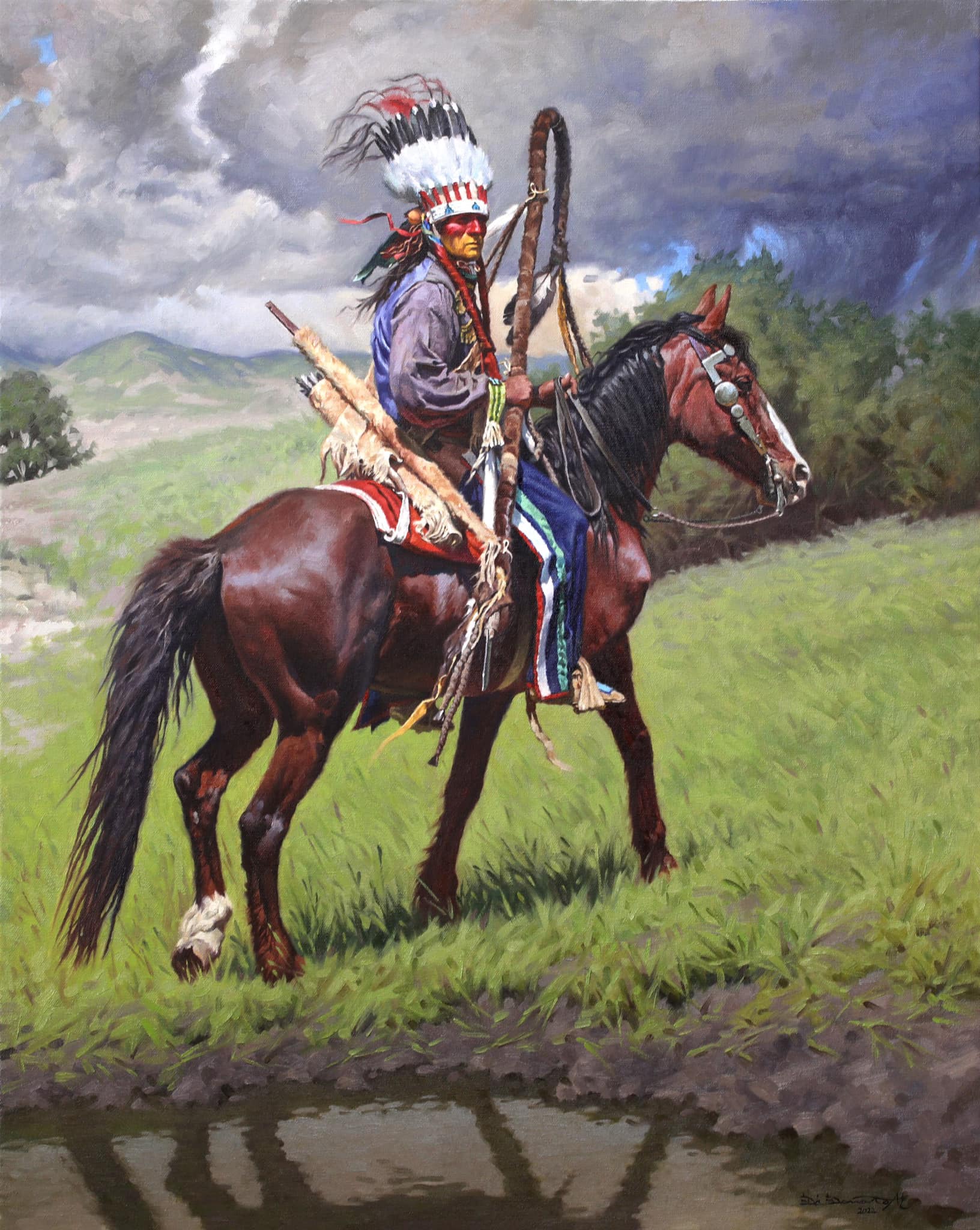
In the Midst of the Storm" is a great painting by Antonio DiDonato. This based on a photo of Ken riding his mustang Phantom. Ken made all items except the stand up Cheyenne bonnet that Curtis Carter created.
Ken Weidner
Although he was born, raised, and continues to be a farmer in SW Kansas, Ken Weidner's true passion is studying the life style of the Plains Indians who also lived in this area. His interest began as a school boy when he wanted to learn how to utilize the hides from the animals he harvested, to making weapons and tools from local materials. This led into years of study, trial and error, and refining the various skills necessary to convert basic birds, animals, and plants (coupled with introduced trade goods) into functional pieces of clothing, weapons, tools, and horse tack necessary for the daily life of the original inhabitants of this area.
Ken's education first began by reading hundreds of books, magazines, and museum publications. When he acquired his first muzzle loading rifle his whole life changed. Soon after he attended his first black powder "rendezvous" and began to attend these events as well as events held at historic sites. He soon put together a portrait of a young white hunter-trapper but when he met a friend, Tom Scarborough, who portrayed a Southern Cheyenne man, all that changed. Tom stressed the importance of time period and tribal style. Soon Ken turned all his focus onto the Southern Cheyenne of the Indian Wars time period. Of course to understand the Southern Cheyenne a person has to have a knowledge of surrounding tribes as well as encroaching white influences. His research continues and is opening up into an interest in Kiowa, Comanche as well as Pawnee.
Participating in various living history events has opened many doors for Ken. Not only has he equipped a fully furnished Southern Cheyenne tipi complete with buffalo robes, parfleches, beadwork, tools, cooking utensils, saddles and horse tack, but he has camped and lived with the equipment to learn how it all works. Learning how an item works is very important, but equally as important is learning how an item does NOT work. The "hands on" trial and error learning is a never-ending education.
One of the steepest learning curves that Ken has encountered is making and using Indian saddles and horse tack. Contrary to popular belief, Plains Indians did use saddles. As nomadic people who were often on the move, having saddles to be able to pack their belongings and make riding more comfortable, was essential. Ken is one of the few people in the world making authentically constructed Indian saddles today. He has been commissioned to make many "hands on" reproduction saddles for various historic sites and museums, as well as for private collections. His saddles can be seen at Little Bighorn Battlefield NHS, Washita Battlefield NPS, Fort Larned NPS, Oklahoma Historical Society Museum, Autry Museum as well as the Smithsonian Institute National Museum of American Indian, as well as many smaller museums and collections.
Through his involvement in living history events, Ken has been invited to participate in various film and movie activities as well. He has held roles as a mounted soldier or warrior in movies such as “Ride with the Devil”, “The Postman”, “Bloody Dawn”, as well as a documentary on the Little Bighorn. TV and movie props and saddle rentals include “The Missing”, “The Homesman”, “The Son”, “The Ballad of Buster Scruggs”, “Montford the Chickasaw Rancher”, and "Sod and Stubble". He and Curtis Carter have worked to equip over two dozen Southern Cheyenne men and women for the movie “Under the Painted Sky”, which now is in post-production. Their goal was to provide the most historically accurate portrayal of Southern Cheyenne people of our time.
One more outlet for his work is in the work of western artists. Ken has been modeling for various artists for over 25 years. In the past six years, he and Curtis Carter have teamed up with photographer Karen Voepel to capture some of the most vivid and intense reference photos that are available. By setting up scenes with accurate reproductions, the reality of the past comes to life in the present. Each photo session gets better, and we are anxious to produce more reference photos for purchase here on this page.
Of course, none of this would be possible without his wonderful support staff. Ken's wife Meg gives him unquestioned love and support. Often he wonders "Why does she put up with me, much less support my projects?". Daughter Lacey and son Tate put their lives on hold for a few days to help their father on the set of “Under the Painted Sky”. With their help as well as other friends the tipi village came to life.
"I would like to thank you for taking the time to visit our page and I hope you like what you see."
Curtis Carter
Curtis Carter is a retired Biology teacher who lives in Poolville, Texas, an hour west of Fort Worth. He has had a lifelong interest in Native American history and material culture. The past 40 years he has concentrated his studies on the life and material culture of the Plains Indians. For at least 30 years, the scope has been narrowed to studying and replicating materials of the Cheyenne tribe. His primary focus currently has been making and using the materials that were part of the daily lives of Cheyenne people from the 1860’s and 1870’s. This includes learning how to tan animal hides the old-time way, how to make archery equipment, horse tack, and a tipi with all the furnishings. His original goal was to be able to get a sense of what the old days were like by replicating these things, and then camping with it to see how all of it actually works, or in some cases how it doesn’t work. This hands-on experience and knowledge have resulted in requests from museums, historic sites, schools, and Plains Indian conferences to lecture on how things were made and used by Cheyenne people in the mid-nineteenth century. Various museums and historic sites have commissioned work from him for hands on learning activities for their education programs.
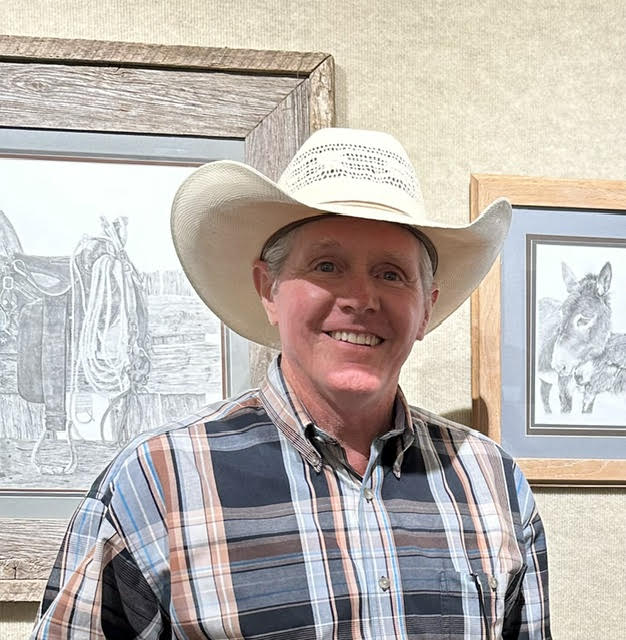
Curtis’ interest has always been in the historic side of things, but in 2019 he and Ken Weidner teamed up to do photo references for western artists. Karen Voepel signed on to do the photography, Ken and Curtis outfit models and set up scenes. Historical accuracy is still of paramount importance, and great pains are taken to try to create scenes in which the clothing and accoutrements are as authentic to the 1860’s and 1870’s as possible.
Karen Vopel
Karen makes her home on the
eastern plains of Colorado. She is a reference photographer for western media artists. Karen is the official photographer for KCK Southern Plains Photography. Her images have been published in several periodicals and she has won numerous awards. Much of her photography is used for marketing ranch life, workshops and retreats. She enjoys working with clients to provide meaningful art work for offices and family homes. She is most inspired by cowboys/cowgirls, horses, bison and the wild prairie which are often her subjects.
Karen is co-founder of Share the Spirit Foundation, Inc.,
providing new shoes to those children less fortunate. She hopes you will be inspired by the American Spirit through her photography. Thus… “Images for life.”
FB page: Karen Voepel Photography
Instagram: kvoepel-photo
“IMAGES FOR LIFE”